


5 Unexpected Things to improve your DnD night
Posted by Matthew Campbell on 9th Oct 2022
you’ve got the dice, books, character sheets, some tiles, a DM screen that frankly takes up
too much of the table, and (of course) snacks. But aside from the obvious luxury upgrades like
bespoke miniatures, deluxe gaming tables and gourmet snacks, what other items might improve
your game? Things that you never even thought of…
Yes, I could have made the obvious “levelling up your game” joke in the title, but it seemed a bit too on the nose, ya know?
Anyway, you’ve got the dice, books, character sheets, some tiles, a DM screen that frankly takes up too much of the table, and (of course) snacks. But aside from the obvious luxury upgrades like bespoke miniatures, deluxe gaming tables and gourmet snacks, what other items might improve your game? Things that you never even thought of…
Jenga
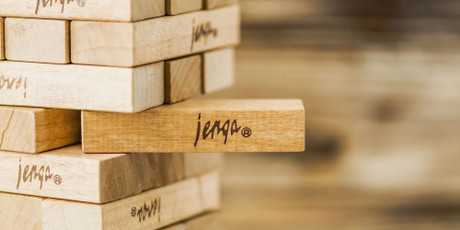
I’m far from the first person to suggest it (and it’s not ideal for every player/table), but Jenga can be a great way to add tension to mechanical resolution. Dice rolls resolve instantaneously, but a Jenga tower provides extended tension, followed by a release. How much of a risk does a character want to take? How quickly must they accomplish a dangerous task, without running out of time or screwing up? Instead of rolling to sneak up on the BBEG, let the rogue get 5 feet closer for every
layer they add before the tower falls…
The Worldbuilder’s Journal
The principal draw of The Worldbuilder's Journal is obvious: the journal comes with 365 prompts for character information. In addition to using it as a daily journal, there are more possibilities. The writing prompts are quite versatile and can be used to foster interactions between players. Even if you use several per session, it’s a resource that’s going to last months.
There’s a second, albeit expensive, brilliance to this book if you ensure each player has a copy: it encourages all sorts of players to write things down. There’s often one player who takes a lot of notes, but having dedicated journals helps spread this around. Got someone who enjoys running the maths on spells and damage? Get them to make their notes in the journal. Wizard’s IC spellbook is an actual book? Now their OC spellbook is one too. This lets all the players do their own thing, but still share a common method for keeping track of the PC’s shared history.
Different Colour Dice
A quick one for when you have new players. Yes, it’s nice when a player gets their first set of fancy, cool-looking dice, but for absolute beginners, don’t give them a matched set. A set in all different colours will significantly speed up the game because the DM can go “the red one” rather than “the pentagonal trapezohedron, no, the other pentagonal trapezohedron”
Spellbook Cards
Spellbook Cards are a bit of a luxury (and also not THAT surprising an inclusion). Yes, it can be quite expensive to get all the packs, and yes, the full spell lists for classes are always changing, and yes, it is information already contained elsewhere, BUT they really are useful. If checking rules and remembering what spells a character has memorised regularly slows down your game, then these come highly recommended.
There are two neat bonus things about cards I should add: one, lots of different companies do lots of different decks, from lenticular cards with little animations on them, to new spells and expanded options. Two, having an established format of spell cards in your game makes it much easier for players and DMs to write their own spells. Wizard finds a weird scroll? Just hand them a slip of paper with the homebrew spell, and they can add it to their cards.
A Chess Set
Coming out of left field, get yourself a cheap chess set. Chess sets are great for combat: for less than a tenner, you get 32 basic ‘miniatures’ that can represent all sorts of enemies – mooks, evil queens, priestly clerics, etc. They come in two colours, giving you both allies and enemies. Because you also get multiples of many pieces, you can have one represent a character on the map and another on the initiative track (a word of caution: your players will squabble over who gets to be the Black Knight). If it’s also a combi draughts and/or backgammon set, you get even more little tokens to do
stuff with.
You also get the board, which can double as a map grid for any square rooms you might be in, and that’s before we even think about building chess-themed puzzles, traps, or contests...Finally, because (dragon) chess exists in the universe, a chess set can give players something quiet to do in character while the DM focuses on other PCs.
Safety Tools (Special Out-of-Listicle Award)
This isn’t something you can buy, but it IS something you should have. Safety tools are there to help everyone have a good time by making sure that the game stays ‘in-bounds’ in both topic and tone. There are many ways to do these, from dedicated processes like X-Cards, to less formal “what I don’t want this game to feature” chats. Talk to your players and find one that suits the group. Far better to spend a short time on Safety Tools than to unexpectedly stumble into a bad emotional situation.
That’s five (six) things that will make your D&D better. Personally, I’ve used all of these at some point or another (though never all in one game). Hopefully there’s something on that list to suit your game and your budget, or maybe you’ve already got one or two of them somewhere (commence rummaging in a cupboard for that Jenga set you think you remember having).
Written by Matthew Campbell