


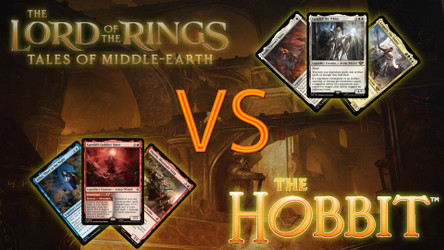
The Hobbit vs Tales of Middle-Earth - A Story of Two MTG Sets
Posted by Magic Madhouse on 27th Aug 2026
MTG's latest Universes Beyond excursion has taken us into the imagination of J.R.R Tolkien for a tour through his first fantasy epic: The Hobbit. This isn't the first time that we've wandered into the Shire and the lands beyond, though, we've actually been there and back again once before in the 2023 set The Lord of the Rings - Tales of Middle-earth.
In many ways, The Hobbit feels similar to Tales of Middle-Earth, they both occur in the same world, they feature some of the same mechanics, and even include some of the same characters. There are also some key differences between the two sets, though. Let's zoom out and take a look at both of MTG's visits to Middle-Earth.
MTG's latest Universes Beyond excursion has taken us into the imagination of J.R.R Tolkien for a tour through his first fantasy epic: The Hobbit. This isn't the first time that we've wandered into the Shire and the lands beyond, though, we've actually been there and back again once before in the 2023 set The Lord of the Rings - Tales of Middle-earth.
In many ways, The Hobbit feels similar to Tales of Middle-Earth, they both occur in the same world, they feature some of the same mechanics, and even include some of the same characters. There are also some key differences between the two sets, though. Let's zoom out and take a look at both of MTG's visits to Middle-Earth.
5 Things That Are the Same
1. The One Ring - Despite being called The One Ring, thanks to The Hobbit, Sauron's most precious possession has now been printed twice. You can crack copies of The Original One Ring in Tales of Middle-Earth Draft Boosters, while the new printing from The Hobbit appears exclusively in Collector Boosters and as a Booster Box Topper.
2. Middle-Earth Classic Artist Cards - The One Ring isn't the only card that shows up in both sets. A collection of "Classic Artist Cards" are available in The Hobbit in Collector Boosters and as box toppers. These Classic Artist cards are all reprints from Tales of Middle-Earth, but with brand new artwork.
3. Amass - Whether it's Sauron or Bolg of the North, Middle-Earth has no shortage of warlords assembling armies. This is represented through the Amass mechanic in both sets. Whenever you Amass, you either create an army token with X +1/+1 counters on it, or put X +1/+1 counters on an army that you already control. Amassing in Tales of Middle-Earth creates an orc army, while amassing in The Hobbit creates a goblin army. In either case, you'll be building up your very own legion of evil minions.
4. Returning Characters - Since both The Hobbit and Tales of Middle-Earth take place in the same world, there are a handful of characters fortunate enough to show up in both sets. In either of these two Tolkienian expansions, you can find Bilbo, Gandalf, Elrond, Gollum, and Lobelia Sackville-Baggins (Bilbo's covetous cousin-in-law). Technically, Smaug also shows up in both sets, the villainous dragon appears on several cards in The Hobbit, and also shows up as a token created by the card There and Back Again in Tales of Middle-Earth.
5. Sagas - Sagas were introduced to MTG in the 2018 set Dominaria. They act as a way of telling three act stories that unfold over the course of several turns. This made them ideal for Tales of Middle-Earth and The Hobbit, since The Lord of the Rings Trilogy and its prequel are both stuffed full of lore, history, and songs ready to be reenacted. There are cards representing the War of the Last Alliance, the tale of The Misty Mountains Cold, and even The Bath Song. Middle-Earth certainly has no shortages of sagas worth sharing.
5 Things That Are Different
1. Different Art Treatments - Cards from both sets are presented in a variety of different artistic styles. The Hobbit features Dragon Scale cards (designed to look like they're wrapped in the grip of Smaug), book cover cards (that resemble classic paperbacks), and both journey and seasonal basic lands among a variety of other treatments. Tales of Middle-Earth, meanwhile, features scroll showcase cards (designed to look like ancient parchment), and ring showcase cards (that show silhouetted versions of characters during their darkest moments). There are also basic lands that resemble maps, showing off the many corners of Middle-Earth, and a selection of other treatments. Although they occur in the same world, noth sets have their own distinct selection of styles.
2. Set Size - The Hobbit is a small set, while Tales of Middle-Earth is a large set. There are 198 cards in The Hobbit, while Tales of Middle-Earth contains 281 cards. This means that The Hobbit has a less complex limited enviroment designed to be easily acccessible to newer players, while Tales of Middle-Earth features a wider range of cards, archetypes, and potential strategies.
3. The Ring Tempts You - When Bilbo Baggins first pilfered the Ring from Gollum during The Hobbit, he had no clue how powerful it truly was. The real corrupting nature of the ancient artifact wasn't discovered until decades later. Because of this, Tales of Middle-Earth features "The Ring Tempts You", a mechanic representing the whispering influence of the dark lord Sauron beguiling those who attempt to wear the ring. This mechanic does not return in The Hobbit since, for all Bilbo knows, there is nothing sinister about his magical new keepsake.
4. Different typal themes - While both sets occur in the same world, there isn't a perfect overlap between the creature types that they feature, and sometimes the same creatures show up, but with an entirely different theme. Curiously there are far more halflings in Tales of Middle-Earth than in The Hobbit. Halflings, and the food tokens that they can cook up, are the theme of the white/green archetype in Tales of Middle-Earth. Humans show up in both sets, but shift from red/white to blue/white, alongside an accompanying strategic shift from aggro into control. There are a few Dwarves in Tales of Middle-Earth, but far more in the Hobbit. Elves are blue and green in both expansion, but in The Hobbit they care about landfall, while in Tales of Middle-Earth they're focused on scrying.
5. Format legality - Tales of Middle-Earth was printed directly into Modern. Even back when it first came out in 2023, it was never legal in Standard, or Pioneer. The cards have only ever been usable in Modern, Commander, Vintage, and other formats. The Hobbit, meanwhile, is the newest set in Standard, and it will still be legal there until 2029, and it'll be Pioneer playable forever.
Conclusion
At the end of the day, whether it's Throin or The Fellowship, Sauron or Smaug, there's no shortage of characters to draw from for sets based in Middle-Earth. Whether you prefer the streamlined experience offered by The Hobbit, or the more complex gameplay offered by Tales of Middle-Earth, both sets have plenty to offer Magic players who are also fans of fantasy literature.
For more updates on the latest MTG Universes Beyond releases, be certain to subscribe to the Magic Madhouse newsletter at the bottom of this page, and follow us on Facebook, YouTube, and Instagram.